How to learn more by studying less: Unlock your new language learning superpower!
“Train your long-term memory with the science of the Spacing Effect.”
Imagine you have to paint a wall. You have two choices:
- Pour all 5 liters of paint on the wall at once and hope it sticks.
- Apply one thin layer, let it dry, then apply another, and another.
We all know the first option is a messy disaster. Yet, when it comes to learning a language, most of us do exactly that. We "pour" 3 hours of Spanish vocab into our heads on a Sunday night and wonder why it’s all on the floor by Monday morning.
The secret to making it stick? The Spacing Effect.
What exactly is the Spacing Effect?
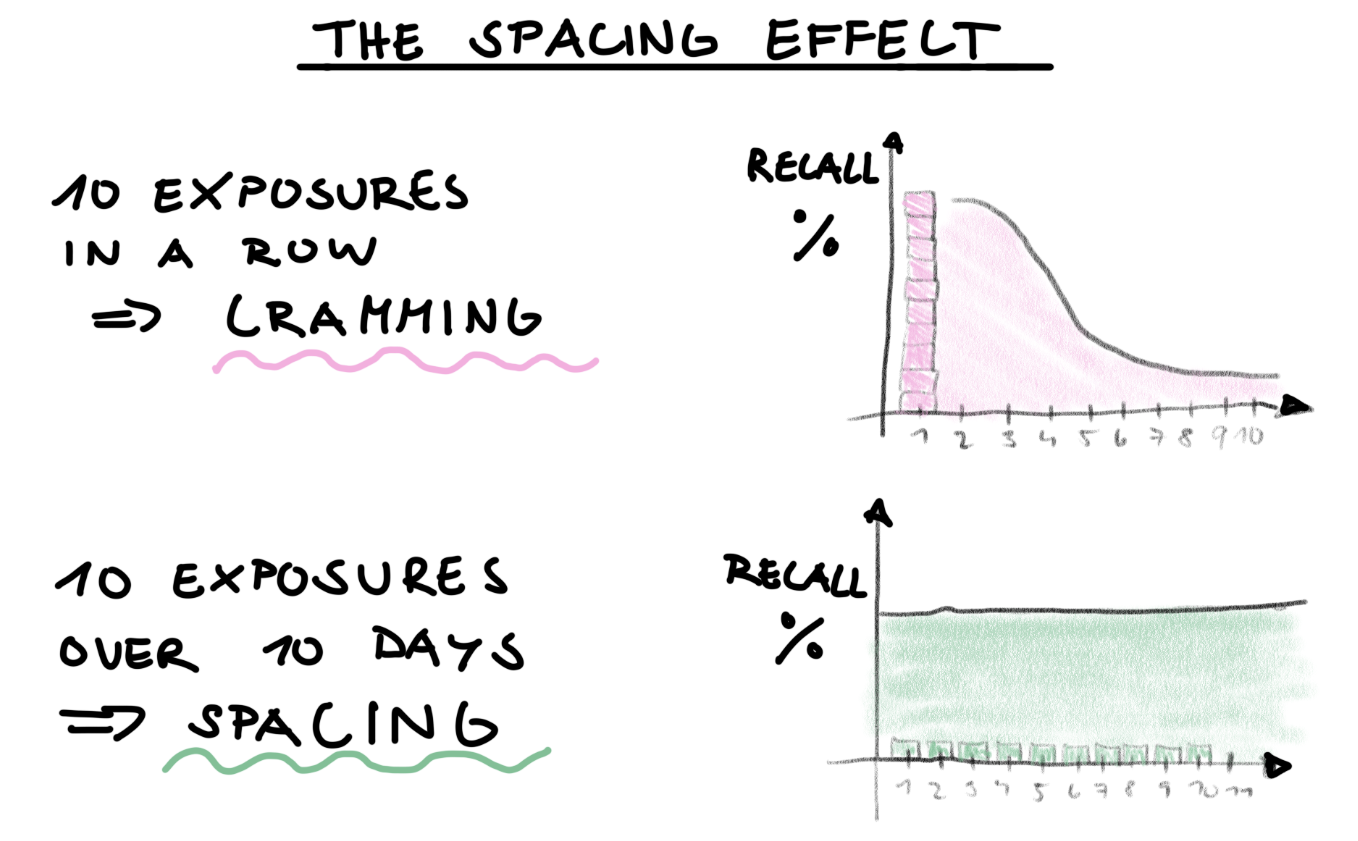
The Spacing Effect is a psychological phenomenon that proves our brains learn more effectively when we space out our study sessions over time, rather than bunching them together (a.k.a. cramming).
It was discovered by our old friend Hermann Ebbinghaus (the "Forgetting Curve" guy). He realized that his brain remembered things much better if he reviewed them over several days instead of repeating them 20 times in one afternoon.
Why does it work? (The Science of “Drying Paint”)
Why is your brain so picky about timing? There are two main reasons:
1. Semantic Priming & Focus
When you repeat a word 10 times in a row ("Manzana, Manzana, Manzana..."), your brain gets bored. After the third time, it stops paying attention because the information is already in your short-term memory. It feels easy, but it’s a fluency illusion. By spacing it out, you force your brain to "re-activate" the word each time, which makes the connection stronger.
2. The Power of Sleep
Science shows that a huge part of memory consolidation happens while you sleep. When you use the Spacing Effect, you’re giving your brain multiple "sleep cycles" to process the new vocabulary. You’re literally building brain tissue while you dream. Read more about how sleep affects language retention and how to optimise your night shift for vocabulary.
Spacing Effect vs. Cramming: The Stats
- Cramming: You feel like you know 100% of the material right now, but you’ll forget 80% of it within 48 hours. It’s a "fake" sense of security.
- Spacing: It feels harder because you have to work to remember. But that effort is exactly what moves the words from your "trash bin" to your long-term memory.
How to use the Spacing Effect like a Pro
You don’t need to be a neuroscientist to use this. You just need a strategy:
- The "Little and Often" Rule: 10 minutes every day is scientifically superior to 70 minutes once a week.
- Trust the "Gap": If you struggle to remember a word after a two-day break, good! That struggle is the Spacing Effect in action. That’s your brain "drying the paint."
- Let the Algorithm do the work: In fact, this scientific principle is exactly what drives tools like Vocabuo. While figuring out the 'perfect gap' for 500 words is a human impossibility, the app solves this by automating the spacing effect for the learner.
Your next step?
Stop drowning your brain in paint! Start using the “language learning superpower” aka Spacing Effect with Vocabuo and learn more by actually studying less (as long as you time it right). If you’re still struggling, check out the biggest mistakes people make when learning vocabulary — you might recognise a few habits worth breaking.
Sources
- Ebbinghaus, H. (1885). Memory: A Contribution to Experimental Psychology. Teachers College, Columbia University. (The foundational research on the Forgetting Curve and the Spacing Effect).
- Dempster, F. N. (1988). The Spacing Effect: A Case Study in the Failure to Apply the Results of Psychological Research. American Psychologist, 43(8), 627–634. (Exploring why spaced learning is superior to massed practice).
- Roediger, H. L., & Pyc, M. A. (2012). Inexpensive techniques to improve education: Applying cognitive psychology to enhance educational practice. Journal of Applied Research in Memory and Cognition, 1(4), 242–248. (Scientific backing for Active Recall and the Testing Effect).
- Walker, M. (2017). Why We Sleep: Unlocking the Power of Sleep and Dreams. Scribner. (Explaining the biological "Save Button" and memory consolidation during sleep).
- Dunlosky, J., et al. (2013). Improving Students’ Learning With Effective Learning Techniques: Promising Directions From Cognitive and Educational Psychology. Psychological Science in the Public Interest, 14(1), 4–58. (A comprehensive review confirming Spaced Practice as a high-utility learning strategy).
- Wikipedia contributors. (2024). Spacing effect. Wikipedia, The Free Encyclopedia. https://en.wikipedia.org/wiki/Spacing_effect
- Wikipedia contributors. (2024). Forgetting curve. Wikipedia, The Free Encyclopedia. https://en.wikipedia.org/wiki/Forgetting_curve
