If you've ever tried to learn a language, you've likely encountered the "Wall of forgetfulness". You learn a word on Monday, recognize it on Tuesday, and by Friday, you have no idea what you were even studying.
For decades, not only students have fought this with "Cramming" - the act of repeating a word 50 times in one sitting, spending 3 hours at once just rereading the same words over and over again. But science has a much more elegant, less exhausting solution: Spaced Repetition (SR).
Spaced Repetition is a learning technique that involves reviewing information at increasing intervals. Instead of bunching your study time together, you spread it out over days, weeks, and months. The goal here is very simple: Review the information exactly at the moment you are about to forget it.
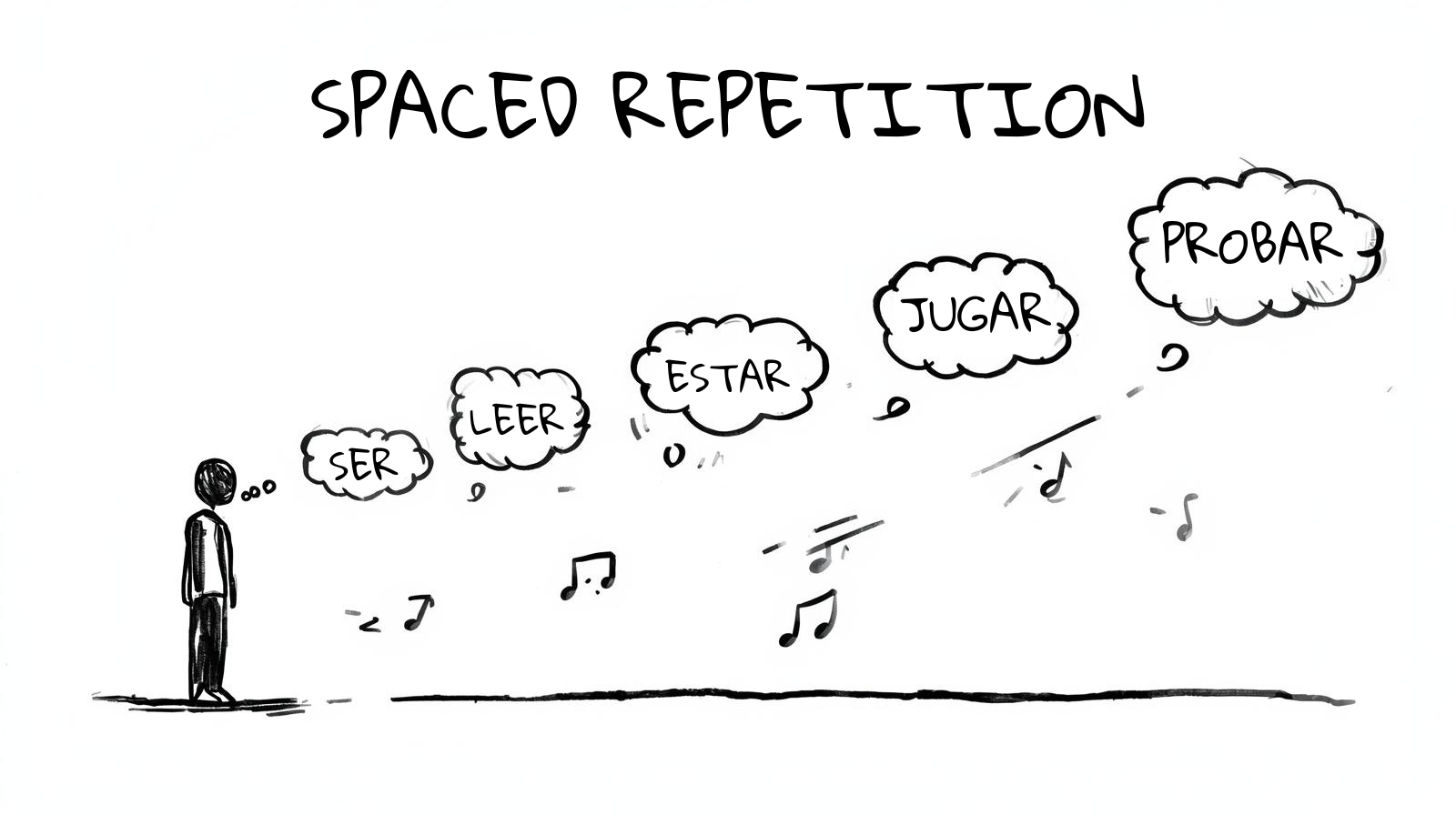
To understand why Spaced repetition works, we have to first look at how neurons communicate. Every time you learn a new vocabulary word, your brain creates a physical connection between neurons.
Think of a new word like a path through a grass field. If you walk it once, the grass springs back up. If you walk it twenty times in one hour, you flatten the grass, but it still grows back by next week. However, if you walk that path once a day for a month, you eventually create a permanent trail. Spaced repetition tells your brain "This information keeps showing up. We need to move this from short-term memory to long-term storage."
Research shows that our brains learn more effectively when we space out our efforts. By allowing a little bit of forgetting to happen between sessions, your brain has to work harder to retrieve the memory. That extra effort is the workout that makes the memory stick. Psychologists call this the Spacing effect.

If Spaced repetition is so great, why doesn't everyone do it? Well, because it's a little bit of a mathematical nightmare to track manually. Imagine this:
You are learning a 1000 new words. That means you need to know which words you learn today, which words you need to see in four days, which words you have mastered and only need to see them again once every blue moon, which words you don't even know you don't know…
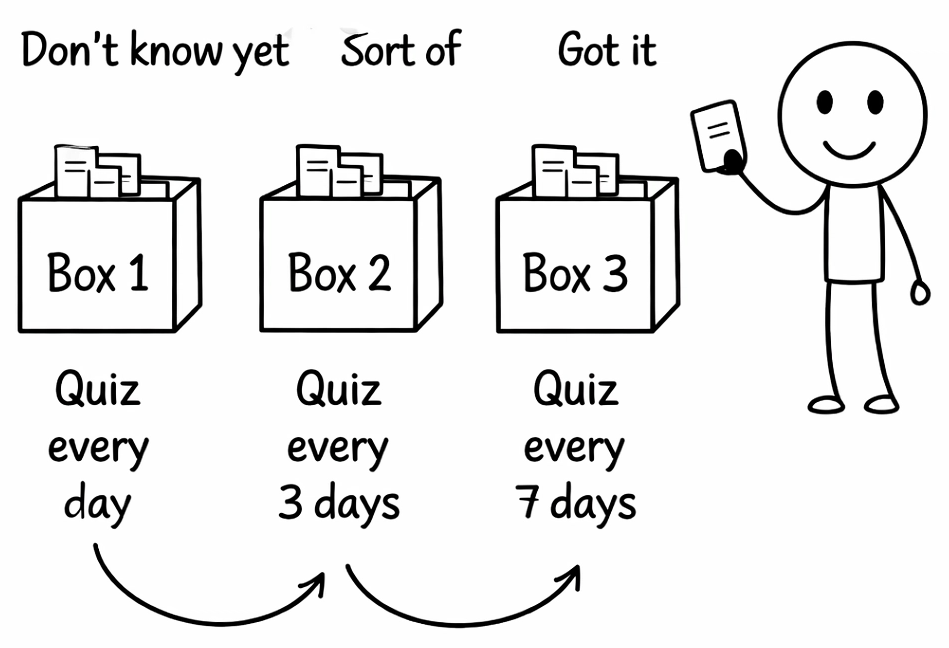
Historically, people used the Leitner system - a physical box method with dividers, where you move your flashcards into boxes. Correctly answered cards move to a less frequent review schedule, while incorrect cards return to daily review. While effective, it's bulky, really time-consuming, and prone to human error.
This is the perfect place where new-age technology meets neuroscience. Vocabuo was designed to take the "math" and all the annoying and time consuming logistics out of your hands.
Our algorithm tracks your performance on every single word. If you're struggling with a verb, Vocabuo will show it to you more frequently. On the other hand if you've already mastered a noun, it will be pushed further into the future so you don't waste time on it.
By using a digital Spaced repetition system (SRS), you ensure that every minute you spend studying is as effective as possible with the right algorithm.
Spaced Repetition isn't just a hack. It's the most scientifically validated method for long-term retention. By moving away from the "Cram and forget" cycle, you aren't just learning faster. You're learning forever.
Ready to see the Spacing effect in action? Start building your permanent vocabulary with Vocabuo today. Available for both iOS and Android!
https://www.bcu.ac.uk/exams-and-revision/best-ways-to-revise/spaced-repetition
https://pubmed.ncbi.nlm.nih.gov/8757093/
https://www.k-state.edu/aac/success-tools/collection/Leitner_System.pdf
