Best Apps for Learning Languages from Authentic Native Content (News, Books & Videos)
Once you move past basic phrases and introductory apps, traditional course materials start to feel artificial. Real progress happens when you consume authentic native content; the news articles, eBooks, podcasts, and YouTube videos that native speakers actually read and watch.
Linguists call this principle Comprehensible Input: acquiring a language naturally by immersing yourself in content you enjoy, while receiving just enough support to understand unfamiliar words without breaking your flow.
However, opening a foreign news site or a raw eBook with a dictionary app open in another tab quickly turns reading into a tedious chore.
To solve this, a new generation of language tools has emerged. Here are the best apps for learning languages from real-world news, books, and videos in 2026.
What Makes a Great Native Content Reader App?
Not all immersion apps are created equal. The best tools share three core attributes:
- Low Lookup Friction: Tap-to-translate functionality so you can look up words in under a second without losing your train of thought.
- Context-Rich Retention: Automatically capturing the full sentence where a word appeared, so you learn how words function naturally.
- Smart Spaced Repetition (SRS): A system to ensure the high-level vocabulary you discover during reading actually makes it into your long-term memory.
1. Vocabuo: Best Overall for Friction-Free Reading, News & Smart AI SRS
If your goal is to turn real-world content into long-term active vocabulary without losing time managing software, Vocabuo offers the cleanest, most modern approach on the market.
Vocabuo is built specifically around the philosophy of context-first learning. It serves as an intuitive reader for web articles, news, and video content. Instead of cluttering your screen with color-coded highlights or complex settings, it presents text cleanly in your target language.
When you encounter an unfamiliar word while reading news or imported articles, a single tap displays an instant definition powered by AI context.
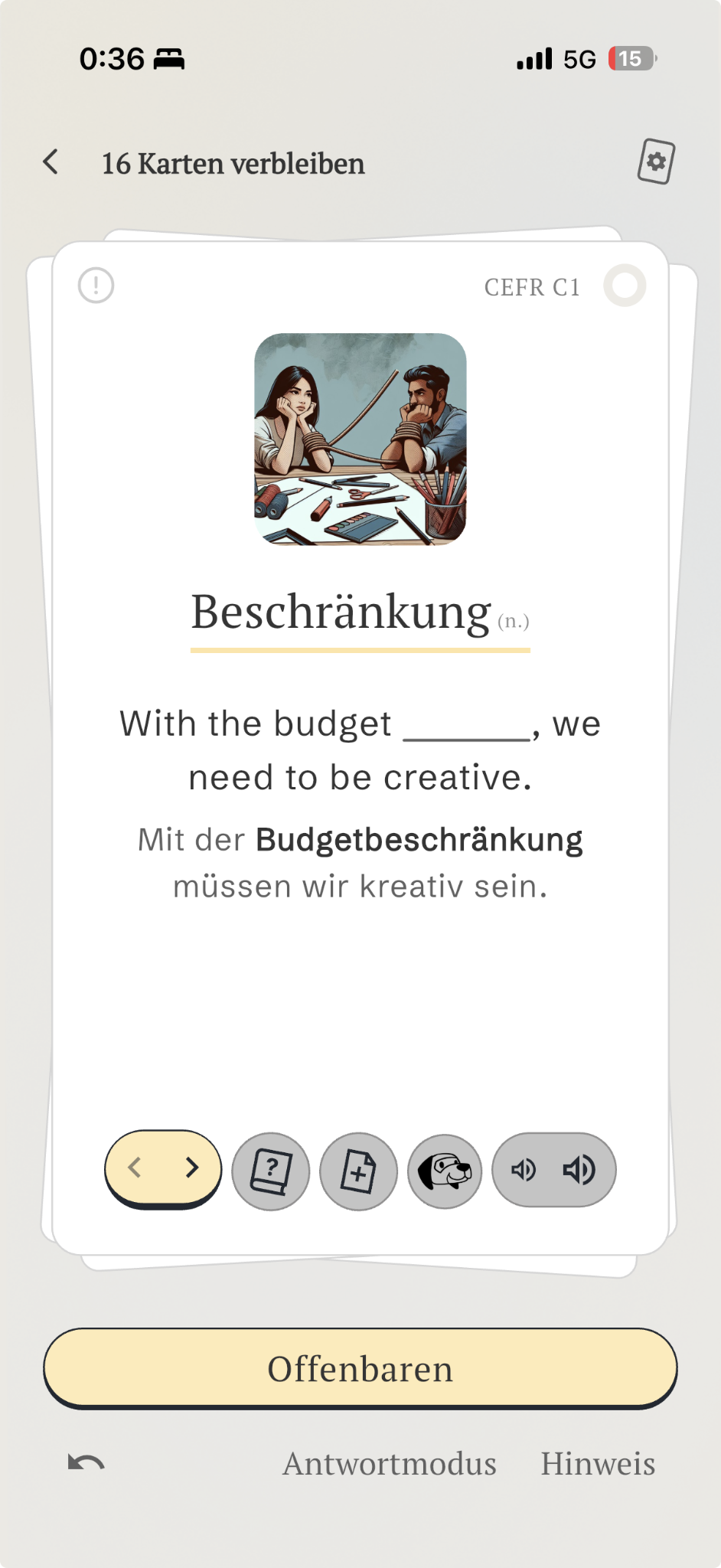
Why it stands out:
- Automatic Sentence Cards: Unlike traditional flashcard systems like Anki, Vocabuo automatically saves the word along with the exact original sentence where you found it.
- Zero-Admin Spaced Repetition: Reviews use an automated Spaced Repetition algorithm to train active recall, making it an essential tool for breaking through the B1 language plateau.
- Minimalist Interface: Designed to keep you focused on reading and watching content rather than organizing software decks.
Best for: Learners who want a fast, modern daily habit for reading real content while letting AI handle their vocabulary retention.
2. LingQ: Best for High-Volume eBook & Podcast Libraries
Founded by polyglot Steve Kaufmann, LingQ is one of the oldest and most extensive platforms dedicated to content-based learning.
LingQ operates as a massive text-parsing hub where you can import long eBooks, audiobooks, and podcast transcripts. Every word in a text is tracked, tracking whether you've seen it, are actively studying it, or already know it.
Strengths:
- Handles large, multi-chapter books and lengthy audio files effortlessly.
- Massive archive of user-contributed native lessons across dozens of languages.
Limitations:
- The visual layout can feel busy, and managing word levels manually often feels like managing a spreadsheet, prompting many users to look for modern LingQ alternatives.
Best for: Hardcore language nerds who want to track every word across massive 500-page eBooks.
3. Langua: Best for Audio & Video Transcripts with AI Chat
Langua focuses heavily on rich audio and visual media, making it a standout tool for learners who prefer podcasts and YouTube videos over static texts.
It provides interactive, line-by-line transcripts for popular native podcasts and video feeds. If you don't understand a section of a video, you can pause, click the words in the transcript, get immediate context, and even engage in an AI chat to discuss the video's topic.
Strengths:
- Excellent synchronization between media playback and interactive transcripts.
- Built-in AI chat features allow you to practice writing and speaking about the content you just watched.
Limitations:
- Subscription tiers are higher than average, and the platform is geared heavily toward desktop and web-based study.
Best for: Audio-visual learners who want to combine YouTube/podcast immersion with AI discussion.
4. Readlang: Best Minimalist Web Browser Extension
If you prefer to browse the internet freely on your desktop browser without transferring text into a dedicated reading app, Readlang is a lightweight solution.
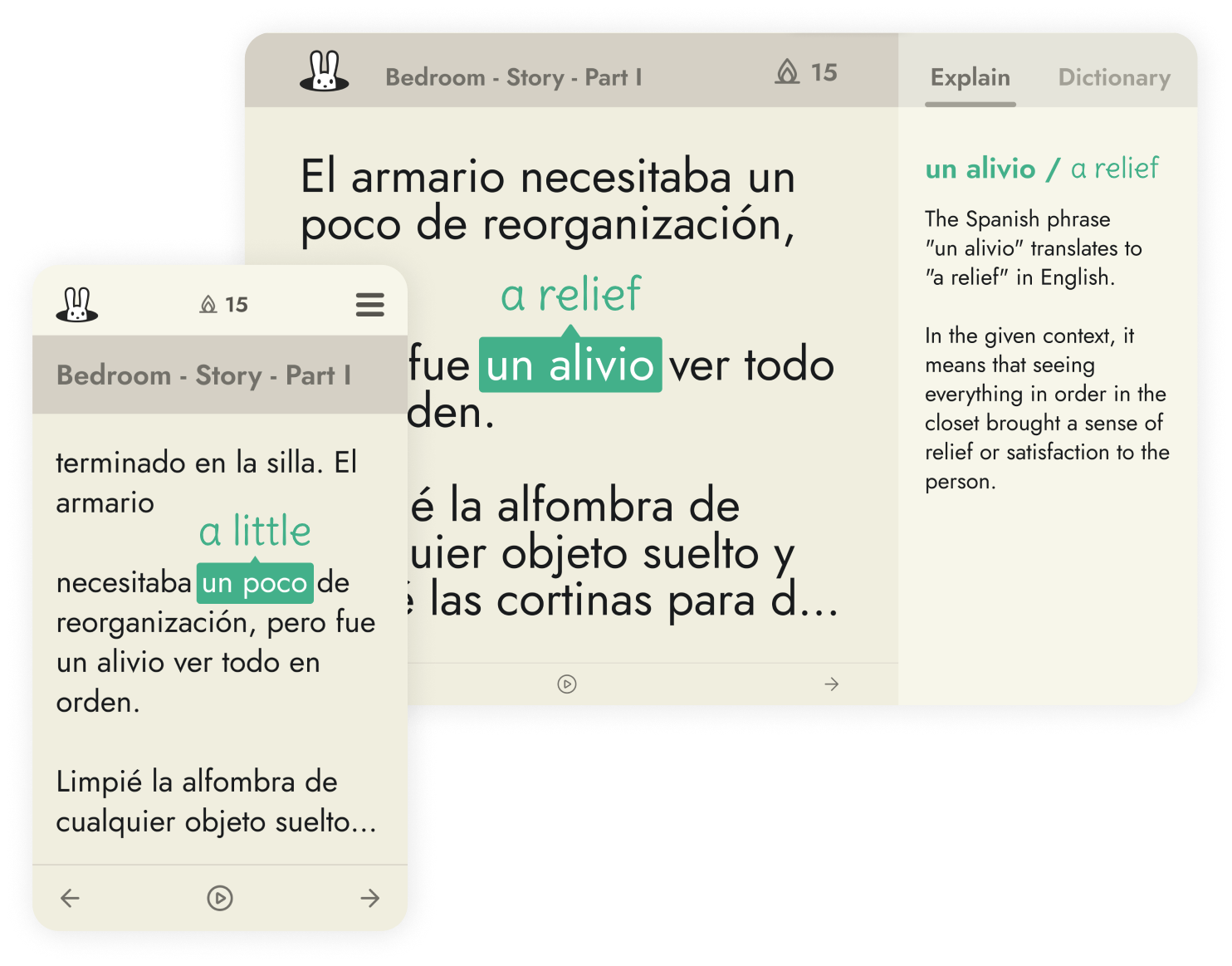
Readlang works as a browser extension on desktop web pages. As you read news outlets like El País, Le Monde, or Der Spiegel, clicking any word displays an instant translation directly above the text and exports the phrase into a basic flashcard deck.
Strengths:
- Works directly on live websites without needing to copy-paste or import text.
- Extremely lightweight with a generous free tier for single-word translations.
Limitations:
- The mobile experience and built-in flashcard SRS tools are simple compared to modern mobile-first applications.
Best for: Desktop users who want a simple translation overlay while reading news on the open web.
5. Beelinguapp: Best Side-by-Side Dual Text for Early Intermediate Readers
For early-stage learners who aren't quite ready for unfiltered native text, Beelinguapp offers a gentler entry point using side-by-side bilingual reading.
The app displays the target language on the top half of your screen and your native language directly below it, complete with audio narration that highlights text karaoke-style as it plays.
Strengths:
- Ideal audio-visual sync for practicing listening comprehension alongside reading.
- Provides a safety net for learners who feel intimidated by single-language texts.
Limitations:
- Having native translations visible continuously can act as a reading crutch, delaying true immersion. In addition, user content import capabilities are limited.
Best for: A2–B1 learners transitioning into reading through narrated short stories and basic news pieces.
Feature Comparison Matrix
| App | Primary Media Type | Translation Method | SRS & Flashcards | Ideal Level |
|---|
| Vocabuo | News, Web Articles, Videos | Single-tap AI context | Automated AI sentence SRS | B1–C2 |
| LingQ | eBooks, Audiobooks, Podcasts | Highlight & word status | Manual / Built-in SRS | B1–C2 |
| Langua | YouTube, Podcasts, Audio | Interactive transcript lookup | Built-in flashcards | B1–C2 |
| Readlang | Web pages (Browser Extension) | Inline word overlay | Basic exportable cards | B1–C2 |
| Beelinguapp | Narrated stories, Audiobooks | Dual-text split screen | Basic saved word list | A2–B1 |
Which Tool Fits Your Workflow?
Learning from authentic native content is the single most effective way to reach true fluency, but choosing the right tool depends on your preferred media:
- If you want to read news and web pages on your computer for free, try Readlang.
- If you love podcasts and YouTube videos, look into Langua.
- If you want to read real news, articles, and videos on your phone while automatically building a long-term active vocabulary without administrative setup, give Vocabuo a try today.
Sources
- Krashen, S. (1982). Principles and Practice in Second Language Acquisition. Pergamon Press. [Link](https://www.sdkrashen.com/)
- Nagy, W. E., Herman, P. A., & Anderson, R. C. (1985). Learning words from context. Reading Research Quarterly, 233-253.
- Nation, I. S. P. (2013). Learning Vocabulary in Another Language. Cambridge University Press.
- Vocabuo Blog. What is Spaced Repetition? [Link](What is Spaced Repetition?)
- Vocabuo Blog. Top 5 Best LingQ Alternatives for Learning Languages from Real Content [Link](https://vocabuo.com/blog/)
- Vocabuo Blog. The Language Learning Plateau: Why You're Stuck at B1 (and How to Break Through) Link

 Learn English
 Learn Spanish
 Learn French
 Learn German
 Learn Italian
 Learn SwedishLearn SmarterDictionaryLook up words in the Vocabuo dictionary.Spaced RepetitionReviews timed to land right before you would forget, so words stick for good.Word ListsLearn exactly the vocabulary you need, from CEFR lists to songs and books.Learn from ContentTurn the books, articles and videos you love into vocabulary lessons.CEFR LevelsA1 to C2 explained, and how to learn the right vocabulary for yours.

