Vocabuo vs. Beelinguapp: Which Reader App Is Best for Building a Native Vocabulary?
If you’ve decided to learn a language by reading real texts, you’re already on the right path. Reading in context is scientifically proven to be one of the fastest ways to expand your vocabulary and absorb natural grammar patterns.
Two apps take this reading-centric philosophy and turn it into a dedicated mobile experience: Beelinguapp and Vocabuo.
While both apps focus on native texts, their underlying technology, user interface, and approach to vocabulary retention are worlds apart. One relies on side-by-side translation, while the other offers a smart AI-powered reader designed to push you toward natural fluency.
So, which one will actually help you bridge the gap between reading and remembering? Let’s break down Vocabuo vs. Beelinguapp.
The Core Concept: Dual-Text Reading vs. Contextual AI Learning
Both apps replace artificial beginner exercises with stories, news, and real-world content. However, how they present the text to your brain is very different.
- Beelinguapp: Uses a classic split-screen (side-by-side) reader. The target language is displayed at the top half of your screen, and your native language translation is displayed directly below it. It also features karaoke-style audio syncing.
- Vocabuo: Uses a clean, single-language reader with instant AI context. You read the text in your target language without clutter or immediate translation spoilers. When you hit an unfamiliar word, a single tap gives you an instant definition, contextual translation, and automatically generates a smart flashcard.
Feature Comparison: Vocabuo vs. Beelinguapp
| Feature | Beelinguapp | Vocabuo |
|---|
| Best For | Lower-intermediate learners who want audio synchronization and full text translations | Intermediate & advanced learners building active vocabulary with zero distractions |
| Reading Format | Dual-text split screen (Target + Native language) | Single-text reader with tap-to-translate & AI assistance |
| Audio Integration | Audiobooks and narrated stories with karaoke-style text highlighting | Integrated audio support for authentic native content |
| Content Library | Pre-selected audiobooks, fairy tales, news, and short stories | Real-world web articles, custom imports, news, and YouTube content |
| Vocabulary Saving | Basic phrasebook & saved word lists | Automated AI contextual flashcards with Spaced Repetition (SRS) |
| Learning Friction | Low, but prone to "translation crutching" | Balanced—encourages immersive focus while keeping lookup effortless |
Where Beelinguapp Shines (and Where It Falls Short)
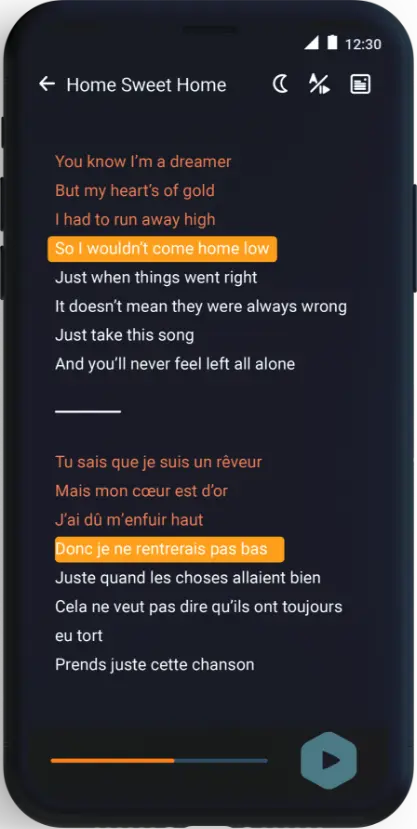
Beelinguapp's signature feature, the split-screen dual text, is a familiar concept for anyone who has ever read bilingual books.
The Good:
- Karaoke Audio Sync: Hearing a native speaker read a story while watching the line-by-line highlighting is great for improving listening comprehension and pronunciation.
- Safety Net for Beginners: Having the full translation of every sentence visible on the lower half of your screen provides comfort if you get completely lost.
The Frustrations:
- The "Split-Screen Crutch": Having your native language right under the target text makes it almost impossible for your brain not to read in your native language. Instead of decoding the foreign language, your eyes constantly dart down to read the easy part.
- Weak Vocabulary Retention Engine: Saving words in Beelinguapp feels like a secondary feature. It lacks a deep, automated review cycle to make sure you actually remember the words week later.
- Fixed Content Library: You are mostly limited to the stories and articles provided inside the app's catalog.
Where Vocabuo Shines
Vocabuo was designed to remove the "translation crutch" while keeping the reading process fast, enjoyable, and effective.
Why Learners Switch to Vocabuo:
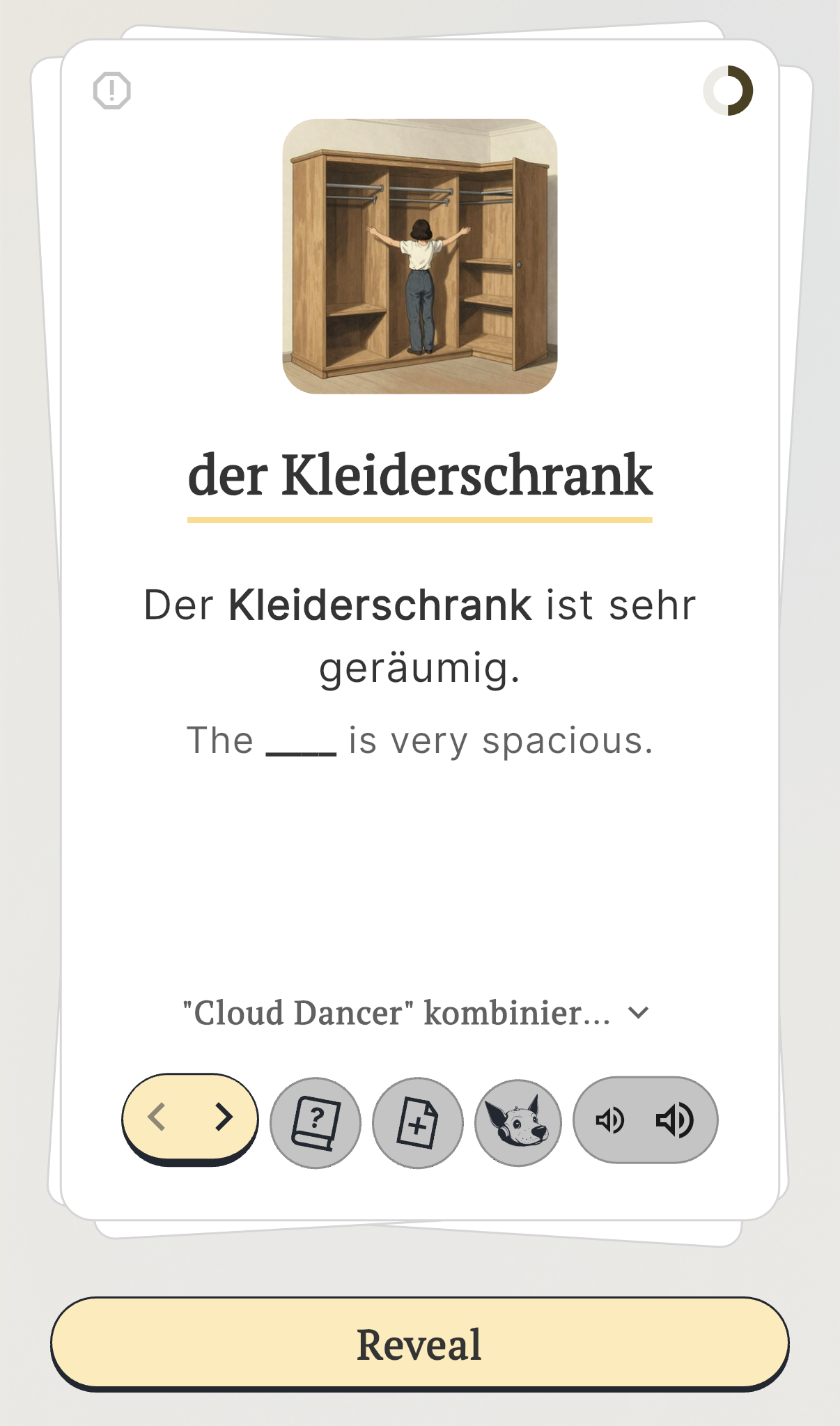 True Immersion Without Frustration: By presenting only the target language on screen, Vocabuo forces your brain to process sentences naturally. If you get stuck, a quick tap gives you instant, AI-generated context without spoiling the rest of the page.
- Automated Contextual SRS: Unlike basic bookmarking, Vocabuo automatically captures the exact sentence where you found a word and turns it into a smart card. Powered by an advanced Spaced Repetition algorithm, it ensures you review words right before you forget them.
- Break the Intermediate Plateau: If you're struggling to break through the B1 language plateau, side-by-side translations won't push you into independent reading. Vocabuo helps you transition to real books, web articles, and videos without feeling overwhelmed.
- Zero Admin Flashcards: Much like our breakdown of Vocabuo vs. Anki, you get all the power of scientifically proven memory tools with zero manual deck-building or card creation.
The Verdict: Which One Should You Choose?
Choose Beelinguapp if:
- You are an early-stage learner (A2–B1) who relies heavily on reading audiobooks along with full native translations.
- You want passive listening practice with line-by-line visual tracking.
Choose Vocabuo if:
- You want to stop relying on native translations and start reading target-language content like a native speaker.
- You want your reading to automatically build an active long-term vocabulary through context-rich flashcards.
- You want to read your own imported web content, news, and videos without being restricted to a fixed story library.
Ready to ditch the translation crutch and read for real? Experience how effortless immersive reading can be when your tools work with your memory, not against it. With Vocabuo.
Sources
- Nation, I. S. P. (2001). Learning Vocabulary in Another Language. Cambridge University Press.
- Krashen, S. (1982). Principles and Practice in Second Language Acquisition. Pergamon Press. [Link](https://www.sdkrashen.com/)
- Laufer, B., & Hulstijn, J. (2001). Incidental vocabulary acquisition in a second language: The construct of task-induced involvement load. Applied Linguistics, 22(1), 1-26.
- Vocabuo Blog. What is Spaced Repetition? [Link](What is Spaced Repetition?)
- Vocabuo Blog. The Language Learning Plateau: Why You're Stuck at B1 (and How to Break Through) Link

 Learn English
 Learn Spanish
 Learn French
 Learn German
 Learn Italian
 Learn SwedishLearn SmarterDictionaryLook up words in the Vocabuo dictionary.Spaced RepetitionReviews timed to land right before you would forget, so words stick for good.Word ListsLearn exactly the vocabulary you need, from CEFR lists to songs and books.Learn from ContentTurn the books, articles and videos you love into vocabulary lessons.CEFR LevelsA1 to C2 explained, and how to learn the right vocabulary for yours.

